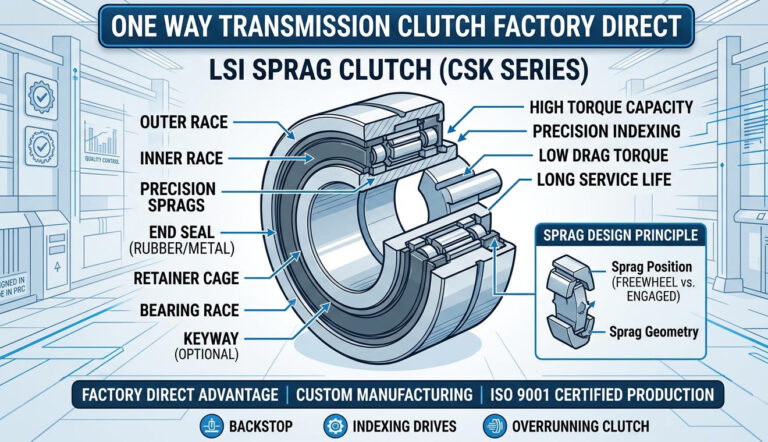


Comprehensive Technical Guide to One-Way Sprag Clutches: Kinematics, Metallurgy, OEM Engineering & Selection
1. Executive Summary & Corporate Engineering Capabilities
In modern high-performance mechanical systems, instantaneous motion control, disengagement safety, and precise position indexing demand torque transmission components capable of zero-backlash engagement. The One-Way Sprag Clutch represents the gold standard in freewheeling technology. Utilizing asymmetric, precision-machined cam-profile wedge elements (sprags), it permits unrestricted rotation in one direction while instantaneously locking solid upon reverse motion.
As a premier manufacturer in the power transmission industry, Auto Sprag Clutch Factory provides custom-designed sprag clutches, freewheel assemblies, and industrial backstops engineered to meet demanding operational challenges. Our manufacturing facility integrates multi-axis CNC grinding, computer-controlled carburizing furnaces, and 100% automated dynamic torque testing lines.
Our complete engineering portfolio includes:
- One-Way Clutches: Precision freewheeling units engineered for high-frequency indexing and overrunning disengagement.
- Sprag Clutches: High-density wedge-cam clutches for aerospace, automotive, mining, and industrial gearboxes.
- Backstop Clutches: Heavy-duty safety reversal protection devices tailored for mining conveyors, crushers, and heavy industrial plant drives.
This technical handbook serves as a definitive resource for design engineers, OEM procurement professionals, and maintenance directors—explaining mechanical kinematics, mathematical torque equations, material science, sizing benchmarks, maintenance practices, and TCO optimization strategies.
2. Mechanical Principles, Sprag Geometry & Kinematic Equations
2.1 The Kinematics of Asymmetric Cam Wedging
Unlike cylindrical roller-ramp clutches, a sprag clutch utilizes non-cylindrical cam-shaped locking elements located between concentric inner and outer cylindrical races. The geometry of each sprag features two distinct contact radii, creating an asymmetric pivot axis.
Kinematic State Comparison:
- Overrunning / Freewheel State: When relative rotation causes the sprags to tilt in a direction where their effective height is smaller than the radial gap between races, the clutch slips smoothly with minimal drag resistance.
- Driving / Engagement State: When rotation reverses, sprags pivot instantly. Because the effective diagonal distance of the sprag profile exceeds the radial space between races, the sprags wedge tightly between races, enabling instantaneous zero-backlash torque transfer.

2.2 Mathematical Wedging & Hertzian Stress Analysis
For a sprag clutch to engage reliably without micro-slippage, the contact wedge angle (alpha) must satisfy the fundamental static friction condition: tan(alpha) <= mu_s
Where mu_s represents the static coefficient of friction between hardened alloy steel surfaces under lubricated conditions (typically 0.06 to 0.10).
The overall dynamic torque capacity depends directly on the total number of installed sprags, normal clamping force, inner race radius, and contact wedge angle. To prevent surface pitting under severe dynamic shock loading, contact stresses must be evaluated against ASME Mechanical Engineering Standards.
3. Dimensional Standards & Technical Specifications
Selecting the appropriate sprag clutch requires careful evaluation of torque limits, shaft tolerances, speed ratings, and housing dimensions. Below is a specification matrix for standard industrial sprag clutches manufactured at Auto Sprag Clutch Factory:
- Model Series: LST-CKA1550 | Inner Bore: 15 mm | Outer Diameter: 50 mm | Width: 16 mm | Max Torque: 110 Nm | Max Inner Overrunning: 3,200 RPM | Max Outer Overrunning: 1,800 RPM | Weight: 0.22 kg
- Model Series: LST-CKA2562 | Inner Bore: 25 mm | Outer Diameter: 62 mm | Width: 20 mm | Max Torque: 320 Nm | Max Inner Overrunning: 2,500 RPM | Max Outer Overrunning: 1,400 RPM | Weight: 0.45 kg
- Model Series: LST-CKA4090 | Inner Bore: 40 mm | Outer Diameter: 90 mm | Width: 27 mm | Max Torque: 1,250 Nm | Max Inner Overrunning: 1,800 RPM | Max Outer Overrunning: 1,000 RPM | Weight: 1.15 kg
- Model Series: LST-CKA60130 | Inner Bore: 60 mm | Outer Diameter: 130 mm | Width: 34 mm | Max Torque: 3,800 Nm | Max Inner Overrunning: 1,300 RPM | Max Outer Overrunning: 750 RPM | Weight: 3.10 kg
- Model Series: LST-CKA90190 | Inner Bore: 90 mm | Outer Diameter: 190 mm | Width: 46 mm | Max Torque: 12,000 Nm | Max Inner Overrunning: 900 RPM | Max Outer Overrunning: 500 RPM | Weight: 8.60 kg
- Model Series: LST-CKD-Custom | Inner Bore: 100-300+ mm | Outer Diameter: Custom | Width: Custom | Max Torque: Up to 180,000 Nm | Max Inner Overrunning: Custom | Max Outer Overrunning: Custom | Weight: Custom
Fitting & Alignment Tolerances
- Inner Race Fit: Shaft journals should be precision-ground to ISO j6 or k6.
- Outer Race Fit: Housing bore machined to ISO H7 or J6 to prevent outer race distortion under peak torque loads.
- Concentricity: Concentricity between inner and outer races must be maintained within 0.025 mm TIR (Total Indicator Reading) to prevent uneven load distribution across individual sprags.
4. Materials Engineering, Heat Treatment & Manufacturing Excellence
The extreme contact pressures exerted on sprag contact points demand advanced alloy metallurgy and tight manufacturing tolerances.
Manufacturing Process Flow:
- Alloy Selection & Vacuum Degassing: SAE 8620H / AISI 52100 bearing grade steel.
- Precision Wire EDM & Cold Drawing: Forming sub-micron accurate sprag cam profiles.
- Atmospheric Carburizing & Quenching: Race surface hardness 60-64 HRC, sprag hardness 62-66 HRC.
- Superfinishing & CNC Internal Grinding: Raceway surface roughness Ra under 0.15 micrometers.
- Dynamic Torque Testing: 100% quality inspection adhering to ISO 9001 quality management guidelines.
Metallurgical Breakdown
- Sprag Elements: Manufactured from ultra-clean AISI 52100 high-carbon chromium bearing steel. Heat treated to 62-66 HRC for maximum resistance against wear and micro-deformation.
- Inner & Outer Races: SAE 8620H or 20CrNiMo carburizing steel. Case-hardened to a depth of 1.2 mm to 2.0 mm with surface hardness of 60-64 HRC and a ductile core to absorb sudden impact loading.
- Garter Springs & Cages: Cages precision-machined from high-tensile brass, aluminum alloy, or engineered polymers. Springs wound from 17-7 PH stainless steel to maintain consistent spring force.
5. Industrial Application Scenarios
Sprag clutches are utilized across a wide variety of demanding industrial sectors:
5.1 Mining & Heavy Bulk Conveyor Systems
On inclined belt conveyors transporting thousands of tons of ore per hour, power failures present grave safety risks. If gravity pulls the loaded belt backward, catastrophic runaway damage occurs. Heavy-duty sprag Backstop Clutches instantly engage the moment forward motion ceases, holding the load safely without backlash.
5.2 Aerospace & Helicopter Main Rotor Drives
Helicopter drive transmissions incorporate dual-redundant sprag clutches between the engine turbine and main rotor gearbox. If an engine experiences power loss in flight, the sprag clutch disengages instantly, allowing the main rotor to autorotate freely and land safely.
5.3 Starter Disconnects & Auxiliary Drives
In gas turbine starter systems, a high-torque sprag clutch engages during initial engine startup. Once the turbine accelerates past starter speed, the sprag clutch automatically shifts into overrunning mode, protecting the starter unit from destructive high-RPM back-driving.
6. Installation, Maintenance & Lubrication Protocol
6.1 Step-by-Step Installation Protocol
- Cleanliness: Thoroughly clean all mounting shafts, housing bores, and keyways with industrial solvent.
- Pressing: Use a uniform sleeve press acting directly on the race being fitted. Never transmit mounting press forces through the internal sprag elements.
- Directional Check: Verify the directional arrow etched on the clutch body indicating freewheel rotation direction prior to final mounting.
6.2 Lubrication Guidelines
Correct lubrication is vital for cooling and reducing drag wear during high-speed overrunning.
- Oil Lubrication: Preferred for high-speed continuous overrunning applications. Synthetic turbine oils or Automatic Transmission Fluid (ATF) complying with ISO VG 32 standards are recommended.
- Grease Lubrication: Suitable for low-speed indexing or backstopping systems under 1,000 RPM. Use specialized non-EP grease formulations. Avoid greases containing molybdenum disulfide or graphite additives, as these cause sprag slippage.
7. Total Cost of Ownership (TCO) & ROI Evaluation
Selecting low-cost, unverified sprag clutches can result in unexpected failures, severe production losses, and safety hazards.
TCO Comparison Matrix:
- Premium OEM Sprag Clutch (Auto Sprag Clutch Factory): High initial precision, minimal maintenance, 5+ years operational lifespan, zero unscheduled downtime.
- Low-Quality Generic Clutch: Low initial cost, frequent maintenance requirements, high risk of early catastrophic failure, massive plant downtime expense.
By sourcing directly from Auto Sprag Clutch Factory, industrial operations achieve:
- High Torque Density: Up to 40% higher torque capacity within compact envelope dimensions compared to standard roller clutches.
- Zero Backlash Engagement: Instantaneous locking protects gearboxes and power transmission components from severe rotational impact spikes.
- OEM Custom Engineering: Direct factory manufacturing tailored to custom shaft dimensions, high-temperature seals, and extreme load ratings.
8. Frequently Asked Questions (FAQ)
Q1: What is the primary difference between a sprag clutch and a roller-ramp clutch?
A: A sprag clutch utilizes asymmetric cam-shaped profiles which provide significantly more contact points within the same diameter, delivering higher torque density and near-zero engagement backlash. Roller-ramp clutches utilize cylindrical rollers riding on tapered wedge ramps, which offer robust performance in highly viscous oil environments.
Q2: Why is rotational direction critical during sprag clutch installation?
A: Sprag clutches are inherently directional. Installing a clutch in reverse will lock the shaft during normal operation and freewheel when power is applied, potentially damaging driving motors or destroying drive gears. Always verify the directional arrow marked on the clutch housing.
Q3: Can Auto Sprag Clutch Factory manufacture custom replacement units for discontinued legacy brands?
A: Yes. At Auto Sprag Clutch Factory, we offer reverse-engineering and direct OEM custom manufacturing services to replace discontinued, hard-to-find, or expensive European and American sprag clutch models with short lead times and factory-direct pricing.