
A sudden mechanical failure in an industrial transmission driveline rarely stays confined to a single component. When a secondary conveyor holdback slips or an overrunning clutch fails under peak load in a high-reduction gearbox, the resulting reverse torque cascades immediately into gear tooth shear, motor rotor overspeeding, and catastrophic structural damage. In bulk material handling, mining, and heavy industrial automation, unexpected backdrive events present severe personnel safety hazards and can easily generate operational downtime losses exceeding $20,000 per hour. Securing absolute mechanical engagement reliability is not merely a component purchasing choice; it is a fundamental risk-mitigation strategy for plant engineers, operations directors, and OEM designers.
Why Choose Our One Way Transmission Clutch Factory Direct Solutions?
Procuring a one way transmission clutch factory direct from a dedicated manufacturer like LST Sprag Clutch eliminates the risks associated with third-party supply chain markups, uncertain metallurgical provenance, and prolonged distributor lead times. By accessing direct engineering support and comprehensive inventory—spanning sprag, roller ramp, and needle roller architectures across standard and custom configurations—procurement teams ensure exact mechanical alignment with their duty-cycle requirements while optimizing life-cycle costs. Explore our comprehensive inventory through our one way clutch for transmission portfolio to align technical specifications with your system architecture.
1. Working Principles and Kinematic Operation
A one-way clutch, commonly designated as an overrunning clutch, backstop, freewheel, or cam clutch, is a precision mechanical device designed to transmit high rotational torque in a specified drive direction while permitting friction-minimized freewheeling in the reverse direction. Unlike actuated friction disc clutches or positive-engagement dog clutches, a one-way mechanical clutch requires no pneumatic, hydraulic, or electromechanical control signals; its engagement and disengagement occur instantaneously based purely on internal kinematic geometry and directional shaft rotation.
Kinematic Geometries: Sprag vs. Roller Ramp vs. Needle Roller
Industrial applications utilize three primary mechanical configurations to execute one-way torque transmission. Selecting the proper architecture dictates load density, permissible overrunning speeds, and overall service life:
- Sprag Type Overrunning Clutch (e.g., ASNU, MG, MZ, FSO, BS, DC, BWC): Utilizes precision-ground, non-cylindrical cam-profiled sprags held in an annular space between circular inner and outer races. An energizing spring (ribbon, garter, or leaf spring) maintains continuous contact between the sprags and races. When the driving member rotates in the drive direction, relative angular motion forces the sprags to pivot outward slightly, wedge securely between the races through a camming action, and transmit torque. When reverse rotation occurs or the driven member exceeds the driving speed, the sprags tilt back, permitting continuous, low-drag overrunning.
- Roller Ramp Overrunning Clutch (e.g., AV, RSBW, TFS): Employs precision cylindrical rollers positioned on machined ramps with specific incline angles on either the inner or outer race. Spring-actuated plungers bias each roller against the wedge angle. Drive rotation wedges the rollers into the narrowing clearance between the ramp and the circular mating race, establishing a rigid mechanical lock. Reverse relative motion pushes the rollers down the ramp against the springs, unlocking the assembly.
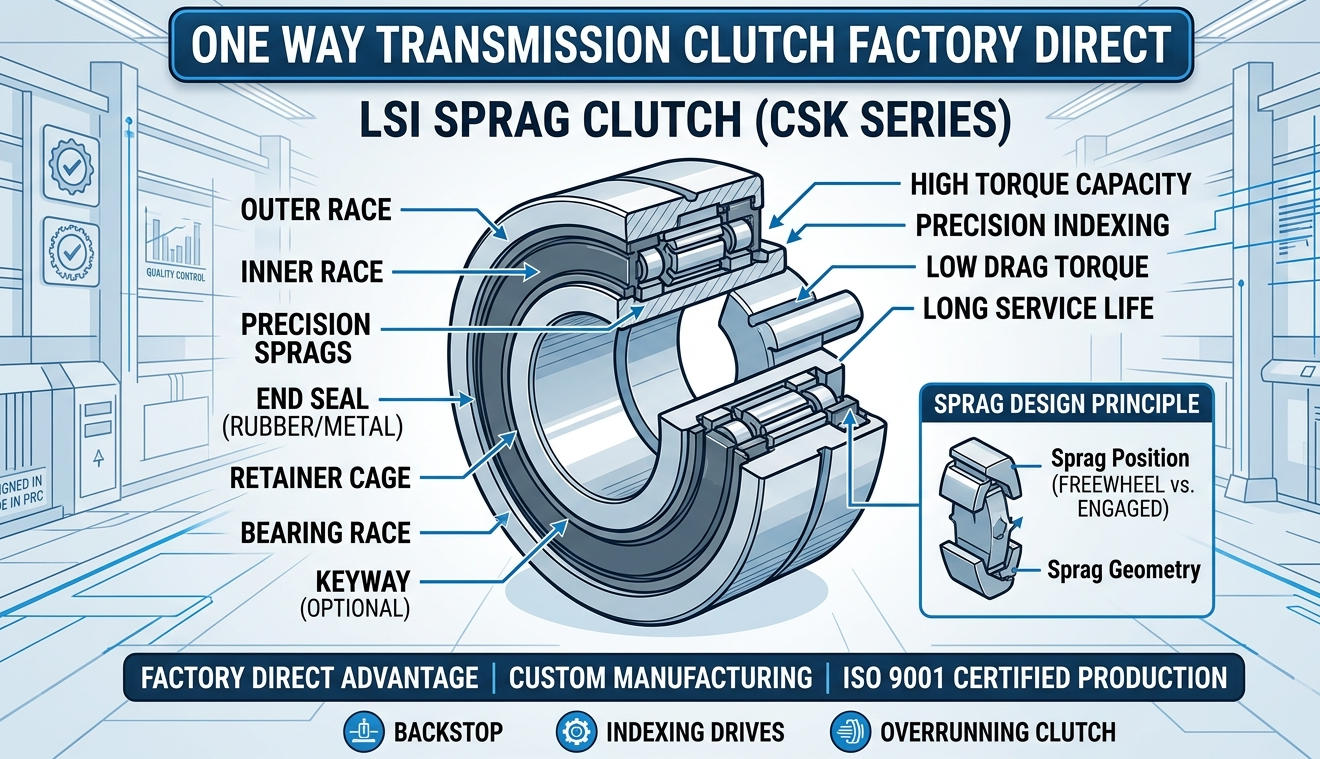
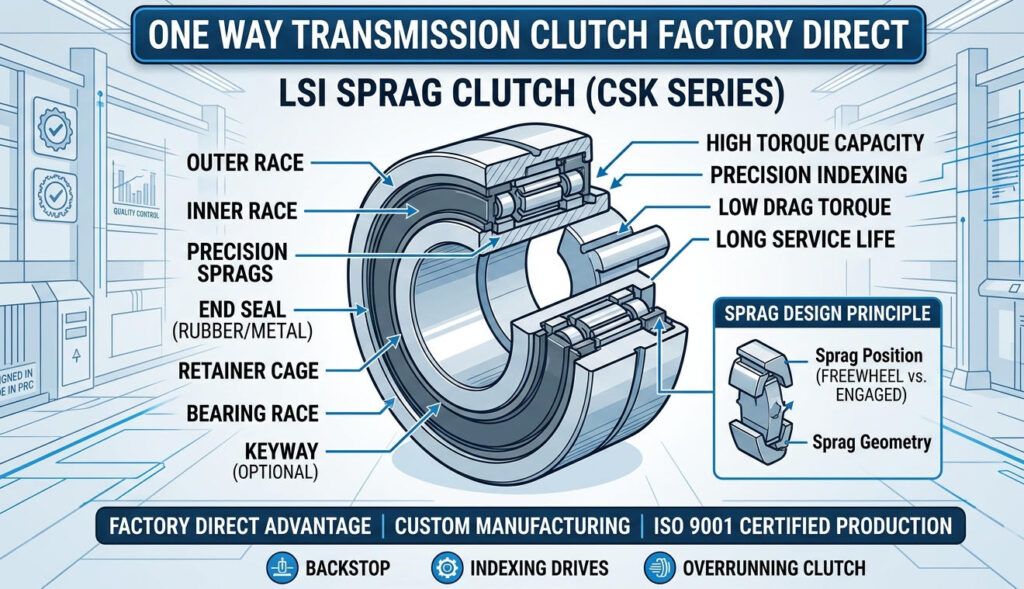
- Needle Roller One-Way Bearing (e.g., CSK, HF, HFL): Compact designs combining a drawn-cup outer ring with ramp profiles and a high-density complement of needle rollers. The CSK series integrates an internal 62.. series deep-groove ball bearing structure to carry combined radial loads and unidirectional torsional loads within a compact form factor matching standard bearing envelopes.
Kinematic Operational Modes
One-way clutches fulfill three distinct engineering functions across powertrain assemblies:
- Overrunning (Freewheeling): Allows a driven shaft to rotate faster than the driving prime mover, preventing reverse torque back-feed into gear motors or starter mechanisms.
- Backstopping (Holdback): Prevents reverse rotation of inclined conveyors, bucket elevators, or industrial pumps when drive power is intentionally or accidentally cut, mechanically holding the load without mechanical braking systems.
- Indexing (Intermittent Feed): Converts reciprocating linear or oscillating angular motion from a hydraulic cylinder or linkage into unidirectional, incremental rotational steps, common in packaging, printing, and automated stamping equipment.
2. Engineering Sizing, Formulas, and Selection Calculations
Undersizing a transmission clutch leads to premature surface fatigue (brinelling), sprag slippage, and immediate component destruction. Conversely, oversizing increases parasitic drag torque, assembly envelope dimensions, and unnecessary capital expenditure. Engineering selection requires evaluating nominal torque, dynamic shock loads, running speeds, and continuous freewheeling thermal limits.
Torque Calculation and Service Factor ($K_s$)
The operational torque capacity ($T_{nom}$) calculated from prime mover power must be adjusted by an empirical service factor ($K_s$) that accounts for prime mover pulsation, driveline inertia, and driven load characteristics.
Imperial Formula:
$$T_{nom} = frac{5252 times P_{HP}}{N_{RPM}} quad text{[lb-ft]}$$
Metric Formula:
$$T_{nom} = frac{9550 times P_{kW}}{n_{RPM}} quad text{[Ncdot m]}$$
The required design torque rating ($T_{req}$) for selecting the clutch model must satisfy:
$$T_{req} = T_{nom} times K_s$$
| Driven Machine Load Classification | Electric Motor / Turbine ($K_s$) | Multi-Cylinder IC Engine ($K_s$) | Single-Cylinder IC Engine ($K_s$) |
|---|---|---|---|
| Steady / Uniform Load: Liquid agitators, centrifugal fans, light-duty belt conveyors | 1.00 – 1.25 | 1.50 | 2.00 |
| Moderate Shock: Machine tools, industrial gearboxes, rotary kilns, packaging machines | 1.50 – 1.75 | 2.00 | 2.50 |
| Severe Shock / Reversing: Bucket elevators, ball mills, vibratory feeders, agricultural balers | 2.00 – 3.00 | 2.50 – 3.50 | 3.50 – 4.50+ |
Centrifugal Lift-Off and Overrunning PV Limits
At high freewheeling speeds, centrifugal force acts upon the sprags. Depending on whether the inner or outer race overruns, designs with centrifugal lift-off sprags utilize mass-counterbalanced geometry: above a critical transition speed ($n_{lift}$), the sprags disengage completely from contact with the opposing race. This hydrodynamic/centrifugal separation reduces wear to zero and eliminates frictional heat generation during continuous high-speed freewheeling.
When selecting non-lift-off sprag or roller clutches, contact pressure ($P$) and sliding surface velocity ($V$) define the continuous operational thermal ceiling:
$$PV = P_{contact} times V_{surface} le PV_{limit}$$
Exceeding recommended $PV$ limits breaks down the hydrodynamic lubricant boundary layer, leading to micro-welding, scuffing, and localized annealing of the bearing steel races.
3. Comprehensive Series Architecture Matrix
LST Sprag Clutch manufactures an extensive portfolio of precision overrunning clutches engineered from high-grade bearing steel (such as vacuum-degassed GCr15 / 52100). Standard product series feature strict geometric runout tolerances, stable locking performance, and low backlash. The table below delineates the structural attributes, torque envelopes, and optimal functional focus for our core industrial product series:
| Series | Kinematic Mechanism | Nominal Torque Envelope (N·m) | Integrated Bearing Support | Primary Operating Mode | Standard Industrial Applications |
|---|---|---|---|---|---|
| CSK / CSK..PP | Sprag Type | 2.5 – 325 | Internal (62.. Series) | Overrunning / Backstop | Fitness apparatus, packaging, small gearboxes, light automation |
| ASNU | Sprag Type (Keyway / Press) | 50 – 4,800 | Requires External Bearings | Overrunning / Indexing | Textile equipment, printing presses, combine machinery |
| MG / MZ | Sprag Type (Heavy Duty) | 400 – 25,000+ | Internal Bushing / Bearing | Backstopping / Overrun | Industrial gearboxes, reducers, inclined conveyor head pulleys |
| FSO | Sprag Type (Flange Mount) | 180 – 35,000+ | Internal Ball Bearings | High-Speed Overrunning | Dual-motor drives, auxiliary turbine starters, cooling tower fans |
| BS | Cam / Sprag (Torque Arm) | 1,000 – 70,000+ | Internal Heavy-Duty | Low-Speed Backstopping | Bucket elevators, aggregate belt conveyors, overland conveyors |
| AV / RSBW | Roller Ramp | 100 – 12,000 | Requires External Bearings | Low-Speed Backstop | Continuous process plants, agricultural elevators, gear reducers |
| TFS | Sprag Type | 15 – 3,500 | Requires External Bearings | Overrunning / Indexing | Precision indexing tables, textile spool winders, machine tools |
| DC / BWC | Sprag Cage Elements | 150 – 8,500 | Direct Shaft / Bore Mount | High-Integration Overrun | Automotive automatic transmissions, starter drives, dual-clutch boxes |
| HF / HFL | Needle Roller One-Way | 1.2 – 200 | Integrated (HFL) or Sleeve | Indexing / Overrun | Office automation, paper feed rollers, instrumentation |
4. In-Depth Focus: Critical Application Sectors
Automotive Transmission Overrunning Clutch and Starter Drives
Modern vehicle powertrain dynamics demand rapid, shock-free directional engagement. In automatic transmissions, hybrid drive transfer cases, and starter drives, our automotive sprag clutch products deliver instantaneous engagement with zero backlash. In multi-speed planetary automatics, DC and BWC cage assemblies smooth shifts between gear ratios by automatically freewheeling when the off-going clutch releases, preventing driveline bind-up without requiring complex electro-hydraulic valving.
During starter motor actuation, the clutch handles high breakaway torque under cold-crank conditions. The moment the internal combustion engine catches and accelerates, the clutch transitions immediately into high-speed overrunning, isolating the starter armature from damaging centrifugal overspeed.
Gearbox One-Way Clutches and Reducer Backstops
Industrial speed reducers powering inclined material transport, continuous bulk processing, or pump lifts require integral holdbacks. Heavy-duty MG, MZ, and BS series units mount directly on gearbox intermediate or intermediate-high speed shafts. By integrating directly into enclosed splash or forced-oil lubrication circuits, these units remain ready to arrest reverse movement instantly should power cut out.
Because they are machined from precision-hardened bearing steel, our gearbox clutches withstand continuous overrunning for tens of thousands of hours without scoring shafts or fatiguing cam races. The low drag torque profile minimizes parasitic driveline efficiency losses, keeping gear reducer operating temperatures within stable parameters.
Agricultural Machinery Clutches: Harvesters, Balers, and PTO Drivelines
Agricultural equipment operates in high-dust, variable-moisture, and severe shock-load environments. Power Take-Off (PTO) shafts connected to high-inertia implements—such as square balers, flail mowers, and combine threshing cylinders—store massive rotational energy. When the tractor operator disengages the PTO clutch or throttles down, this inertia drives energy backward into the tractor transmission, causing severe gear shear or tractor run-on.
Our heavy-duty roller ramp and sprag-type agricultural clutches absorb instantaneous torque spikes while allowing high-inertia implements to freewheel safely to a controlled stop. Sealed assemblies protect the internal cam surfaces from agricultural dust, abrasive chaff, and moisture intrusion, ensuring field reliability through demanding harvest windows.
5. Metallurgy, Heat Treatment, and Quality Standards
The structural integrity of a one-way transmission clutch rests on contact fatigue resistance. When sprags wedge between the races during peak-torque events, localized Hertzian contact stresses can exceed 3,000 MPa (435,000 psi). Insufficient core toughness or inadequate case hardness causes immediate micro-cracking, race indentations, and catastrophic slip-through.
Steel Grade and Thermal Processing Specifications
- Material Grade: High-carbon chromium bearing steel (GCr15 conforming to ASTM 52100 / EN 100Cr6) is used across inner races, outer races, and sprag elements. For high-impact shock applications, carburizing grades such as 20CrNiMo (SAE 8620) provide ductile core characteristics with wear-resistant surface profiles.
- Through-Hardening & Martensitic Quenching: Bearing rings and sprags are vacuum heat-treated to an operational surface hardness of 60 to 64 HRC. This hardness level ensures high resistance against plastic deformation under heavy shock wedging.
- Precision Grinding and Superfinishing: Races are ground to raceway surface finishes of Ra ≤ 0.2 to 0.4 μm with roundness and cylindricity maintained within ISO P6/P5 tolerance classes. This ultra-smooth interface maintains continuous hydrodynamic lubrication films during freewheeling, suppressing frictional heating.
Compliance with Global Standards
Industrial machinery deployed across the North American market must meet strict safety, dimensional, and design codes:
- OSHA 1910.212 / 1926.555: Mandates mechanical backstops on inclined conveyors and bucket elevators to prevent uncontrolled reverse movement that could injure personnel or damage property.
- ANSI / AGMA 6013: Standard for industrial gear drives, governing the mechanical ratings, thermal ratings, and service factors for backstops integrated into gear reducers.
- ISO 9001:2015: Governs manufacturing consistency, raw material metallurgical batch testing, non-destructive testing (NDT), and dimensional verification across all production runs.
6. Total Cost of Ownership (TCO): Factory-Direct Procurement vs. Distribution Tiers
Industrial procurement teams often underestimate the true life-cycle impact of buying brand-labeled components through layered distribution networks. While distributor pricing includes multi-tiered channel margins, the largest hidden costs originate from supply chain delays, stockouts, and lack of technical customization.
| Cost & Performance Driver | Conventional Multi-Tier Distribution | LST Sprag Clutch Factory-Direct Model |
|---|---|---|
| Initial Unit Capex | Elevated 35% – 60% due to regional dealer markups | Direct factory pricing with volume tiering |
| Order Lead Time | 8 to 16 weeks for backordered or non-standard models | 1-Week lead time on standard in-stock inventory |
| Engineering Integration | Distributor sales reps with limited metallurgical expertise | Direct communication with manufacturing engineers |
| Custom Size Availability | High minimum order quantities (MOQs) and prolonged tooling lead times | Custom non-standard dimensions and shaft configurations available |
| Prototyping & Sampling | Paid samples with standard distributor markup | Samples provided (freight collect) for OEM validation |
| Unplanned Downtime Risk | High risk of extended facility outages during replacement stockouts | Rapid air freight dispatch from dedicated factory safety stocks |
7. Step-by-Step OEM/MRO Procurement and Installation Checklist
Follow this systematic technical validation procedure when designing a new assembly or sourcing a drop-in replacement:
Phase 1: Mechanical Interface Validation
- [ ] Shaft Tolerances: Confirm shaft fit complies with ISO h6 or j6 for press-fit designs (e.g., CSK, ASNU). Ensure shaft runout does not exceed 0.02 mm TIR (Total Indicator Reading) to prevent localized sprag pinch.
- [ ] Housing Tolerances: Verify outer housing bore meets H7 or K7 tolerances. For keyway-less friction-fit sleeves, verify housing radial wall thickness resists expansion under peak wedging force.
- [ ] Shaft Concentricity & Bearing Support: For bearingless models (ASNU, AV, TFS), verify external bearings keep angular misalignment between inner and outer races below ≤ 2 arcminutes.
Phase 2: Operational and Dynamic Boundary Checks
- [ ] Rotation Direction Confirmation: Physically identify drive rotation versus freewheeling rotation relative to shaft perspective prior to pressing the unit into the housing (most units can be inverted for left-hand vs. right-hand drive).
- [ ] Speed Envelope Verification: Check both inner-race and outer-race operational speeds against maximum permitted continuous overrunning RPM limits.
- [ ] Lubrication Selection:
- Oil Bath: Standard ISO VG 32 to VG 68 industrial turbine oils without extreme-pressure (EP) additives. Caution: Avoid gear oils containing graphite, MoS2, or high-friction-modifying EP additives, as they lower contact friction and cause sprags to slip under load.
- Grease Lubrication: Lithium-based soap greases without solid lubricants for sealed configurations; do not overfill beyond 30% to 50% cavity volume to prevent churning heat.
Phase 3: Supplier Factory-Direct Verification
- [ ] Sample Validation: Request physical prototype samples for dyno-bench fatigue verification (available with freight collect).
- [ ] Lead Time & Safety Stock: Confirm standard models align with our reliable one-week lead time schedule.
- [ ] Custom Dimensional Prints: For retrofit programs where legacy shafts cannot be remachined, submit CAD prints directly for precision ground custom internal/external diameters.
8. Frequently Asked Questions (FAQ)
What is the typical failure mode of a one-way clutch, and how can it be prevented?
The three most common failure modes are sprag slippage, surface fatigue pitting (brinelling), and spring fatigue. Slippage is almost universally caused by contaminated lubrication or incorrect use of extreme-pressure (EP) lubricants containing slick friction modifiers that prevent mechanical wedging. Pitting results from operation under severe shock loads without an adequate service factor ($K_s$). Spring fatigue happens when rapid torsional vibration causes sprag flutter. These issues are avoided by properly sizing the clutch based on system shock factors, specifying clean, additive-compliant ISO VG non-EP oils, and adhering to strict shaft concentricity limits (≤ 0.02 mm).
Can one-way clutches support combined radial and axial loads?
Certain series—such as the CSK and HFL—integrate internal bearing raceways and balls/needles to support moderate radial loads within a unified envelope. However, most pure sprag and roller ramp models (like ASNU, TFS, and AV) contain no internal bearings and can support torque transmission only. In these cases, separate support bearings (such as deep groove ball bearings or cylindrical roller bearings) must be installed adjacent to the clutch to maintain concentricity and carry external radial and axial forces.
What are the critical advantages of sourcing one way transmission clutches factory direct from LST Sprag Clutch?
Sourcing factory direct removes unnecessary third-party dealer markups, giving you direct access to competitive unit pricing. Furthermore, you work directly with our engineering team to review mating prints, verify torque calculations, and select the optimal series (AV, ASNU, MG, MZ, FSO, BS, TFS, DC, BWC, RSBW, CSK, HF, or HFL). LST maintains extensive standard inventory in stock for a one-week standard lead time, offers custom dimensional machining, and provides functional test samples with freight collect.
Can I reverse the engagement direction of an installed clutch?
Yes. The vast majority of symmetrical one-way clutches (such as CSK, ASNU, and MG series) are non-directional prior to mounting. The engagement direction is determined simply by the physical orientation in which the clutch is installed on the shaft. By pressing off the unit, turning it axially 180 degrees, and reinstalling it, you swap the drive and freewheeling directions. Some heavy-duty flange-mounted backstops (such as BS or FSO) have designated internal designs; for these models, specify preferred shaft rotation when submitting your procurement specifications.
Direct-Source Engineering Support and Availability
Whether you are designing a high-efficiency automotive transmission system, building an overland conveyor backstop, or replacing an obsolete metric freewheel on an industrial production line, LST Sprag Clutch provides precision-engineered components with stable locking performance, low backlash, and long service lives. Browse our full technical catalog at our one way clutch for transmission resource hub or contact our technical sales team directly to schedule sample dispatches and secure factory-direct pricing for your operational footprint.Overrunning Clutch
