
Industrial Bearings Suppliers in Erbil: Engineering Selection, Backstop Systems, and Sourcing Guide
In continuous process operations across Erbil and the wider Kurdistan Region—ranging from aggregate processing and cement manufacturing to commercial packaging and grain handling—an uncommanded reverse rotation or drive slip is not merely a mechanical failure; it is a catastrophic operational event. A sudden rollback on a loaded inclined conveyor belt or a failure in a heavy-duty industrial reducer can cause severe equipment damage, motor burnout, extensive secondary structural destruction, and significant safety hazards for maintenance personnel.
Procuring mechanical components in Northern Iraq demands a rigorous engineering approach. Plant managers, operations directors, and procurement specialists searching for reliable bearings suppliers in Erbil must move beyond basic catalog cross-referencing. Securing long-term plant uptime requires evaluating components on metallurgy, torque density, dynamic freewheel drag, and mechanical anti-reversing integrity under challenging operational conditions. This technical guide outlines the engineering principles, standard series specifications, mathematical calculation frameworks, and total cost of ownership (TCO) benchmarks necessary for selecting and sourcing high-performance one-way bearings, sprag clutches, and conveyor holdbacks.
1. Industrial Operating Realities in the Erbil Industrial Zone
The industrial corridor surrounding Erbil, spanning the Gwer, Kalak, and Makhmur road industrial clusters, presents specific environmental and mechanical challenges that accelerate component wear in standard power transmission assemblies:
- High Ambient Thermal Variance: Ambient operating temperatures regularly exceed 45°C during summer months, leading to localized oil film breakdown, viscosity shear, and premature elastomer seal failure in standard bearings.
- Fine Particulate Ingress: Dust, limestone particulate, and airborne grit from aggregate crushing, asphalt production, and construction material handling enter unsealed bearing cavities, causing abrasive wear on precision-ground engagement ramps and sprags.
- Severe Shock Loading: Intermittent aggregate feeding, frequent motor restarts under full capacity, and heavy mechanical shock subject gearboxes and backstops to severe peak torque loads exceeding 250% to 300% of nominal drive ratings.
Addressing these conditions requires moving away from generic commercial-grade rolling bearings toward purpose-engineered, high-grade bearing steel mechanical motion control units. Selecting the correct one-way clutch for transmission systems ensures mechanical holdback protection and operational reliability across drive lines.
2. Kinematics and Working Principles of One-Way Bearings & Sprag Clutches
A one-way bearing—frequently designated as an overrunning clutch, backstop, holdback, or freewheel—is an engineered mechanical device designed to transmit torque in one relative rotational direction while permitting unhindered freewheeling in the reverse direction. Unlike standard anti-friction bearings (radial ball or cylindrical roller bearings) designed solely to carry radial and thrust loads with minimal friction, one-way clutches switch dynamically between instantaneous mechanical engagement and friction-minimized overrunning.
2.1 Sprag Profile Kinematics
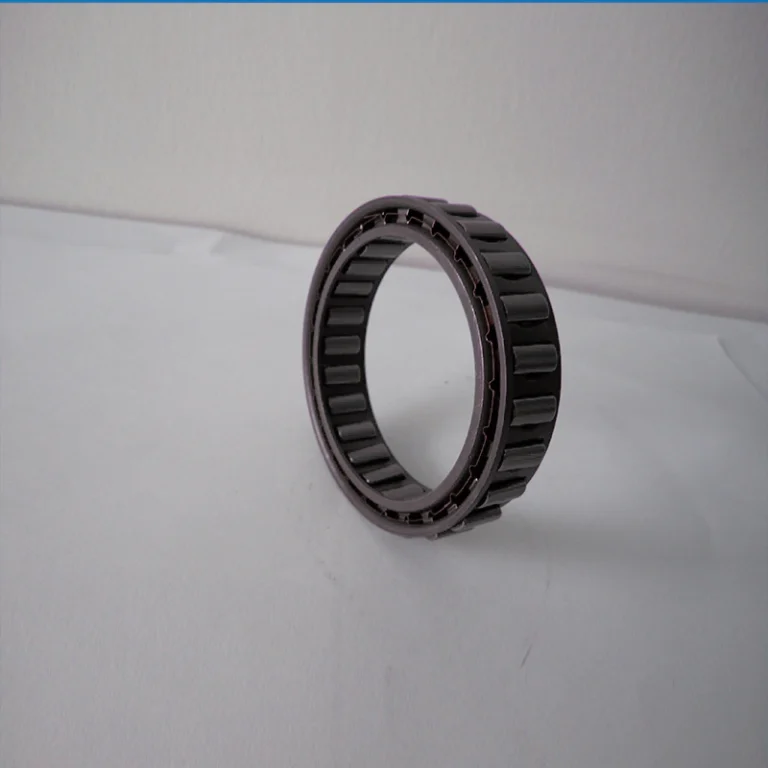
A sprag clutch utilizes precision-machined, asymmetrical, cam-shaped engagement elements positioned within an annular space between concentric cylindrical inner and outer races. When relative rotation occurs in the drive direction, the sprag profile geometry causes each element to wedge securely between the races through frictional contact. This creates a solid mechanical lock that transmits continuous torque without slippage.
When relative rotation shifts to the overrunning direction, the sprags cam outward or tilt smoothly, breaking contact pressure and allowing the inner or outer race to spin freely on a continuous hydrodynamic fluid film or rolling element boundary layer. The mechanical advantage is governed by the contact angle (α), engineered precisely so that the tangent of the contact angle is consistently smaller than the friction coefficient (μ) between the hardened race and the sprag surface:
tan(α) < μ
This geometric condition guarantees instantaneous locking under load, preventing any measurable backward slip or back-drive lash that could damage upstream drive components.
2.2 Ramp-and-Roller Mechanisms
Ramp-and-roller clutches feature a cylindrical outer race and an inner race manufactured with inclined ramp tracks. Hardened precision steel rollers are positioned on each ramp, biased against the ramp slope by individual spring-loaded push pins. During driving engagement, the rollers wedge firmly into the converging taper between the race and ramp, locking the assembly. During freewheeling, the rollers compress their springs and ride back toward the deeper section of the pocket, breaking the drive connection.
3. Technical Specifications: LST Sprag Clutch Product Matrix
LST Sprag Clutch engineers and manufactures an extensive range of overrunning clutches, industrial backstops, and one-way bearings. Constructed from high-integrity bearing steel, these components deliver stable torque transmission, low wear during overrunning, and reliable anti-reverse performance under heavy shock loads.
Procurement teams sourcing for legacy industrial drives, specialized European production machinery, or Asian-manufactured conveyor systems can evaluate standard off-the-shelf and custom options across several major series:
Table 1: Industrial One-Way Bearing & Sprag Clutch Technical Matrix
| Series Identifier | Internal Design Type | Mounting Configuration | Lubrication Compatibility | Primary Industrial Application |
|---|---|---|---|---|
| CSK / CSK..2RS | Sprag with integrated 62.. series ball bearing | Keyway (P/PP) or standard press-fit fitment | Grease pre-lubricated (sealed or unsealed) | Packaging machinery, textile equipment, light reducers |
| ASNU | Roller ramp overrunning clutch | Outer race keyway to housing; inner press-fit | Oil bath or circulating oil systems | Medium-duty industrial gearboxes, general machines |
| AV | Roller type with external centering flange | Bolted end-plate flange to housing | Oil or grease lubricated | Overrunning drives, auxiliary engine drives |
| MG / MZ | High-torque cam / sprag clutch | Keyed inner shaft; outer race bolted or torque-armed | Oil bath with sight glass (MZ grease shielded) | Conveyor drives, bucket elevator head shafts, mixers |
| FSO | Flanged sprag overrunning clutch | Bolted outer face flange; keyed inner bore | Positive oil lubrication with integrated seals | High overrunning inner-race speeds, fans, blowers |
| BS | Heavy-duty cam backstop / holdback | Direct head-shaft key; integrated safety torque arm | Sealed oil bath with external reservoir | Inclined belt conveyors, large vertical bucket elevators |
| TFS | Sprag overrunning clutch without bearing support | Interference press-fit (requires adjacent bearings) | Oil bath (immersion in host gearbox housing) | Compact multi-speed gear transmissions, machine tools |
| DC / BWC | Sprag cage assemblies (raceless elements) | Direct placement between customer-hardened shafts/bores | Direct continuous gear oil immersion | Integrated transmission units, high-density reducers |
| RSBW | Low-speed backstop with torque arm | Keyed to shaft; integrated outer torque-restraining arm | Mineral oil or heavy industrial grease | Quarry conveyors, bulk material processing plants |
| HF / HFL | Needle roller one-way clutch | Thin-walled drawn cup press-fit | Light factory grease | High-speed indexing, office and packaging automation |
For custom retrofit operations on legacy transmissions, review specific dimensional and torque constraints directly through the automotive and industrial sprag clutches division, which provides custom engineering solutions for tailored bore sizes, keyways, and integrated flange geometries.
4. Engineering Calculation Framework: Sizing Backstops for Heavy Drives
Undersizing a backstop or one-way clutch is a leading cause of premature failure in industrial plants. Drive designers and plant engineers must compute operational parameters that account for peak dynamic back-driving torque, rather than relying solely on nominal motor nameplate ratings.
4.1 Nominal Drive Torque Calculation
Nominal operating torque ($T_N$) generated at the driving or driven shaft is calculated using motor power and operating angular velocity:
TN = (P × 9550) / n
Where:
- TN: Nominal shaft torque in Newton-meters (Nm)
- P: Transmitted drive power in kilowatts (kW)
- n: Shaft rotational speed in revolutions per minute (RPM)
- 9550: Conversion constant for SI units
4.2 Critical Safety Factor Formulation
The required rated holding torque capacity of the backstop ($T_{req}$) must be scaled using an engineering service factor ($S_f$):
Treq = TN × Sf
The service factor accounts for motor breakdown torque, dynamic back-bounce when the drive shuts down, dynamic elasticity in belt systems, and severe particulate shock loads.
Table 2: Minimum Engineering Service Factors (Sf) by Application
| Application Class & Drive Configuration | Operating Profile | Recommended Minimum Sf |
|---|---|---|
| Inclined Belt Conveyor (Uniform Load) | Continuous, steady aggregate feed, soft starters | 1.5 – 1.8 |
| Inclined Belt Conveyor (Non-Uniform / Heavy Shock) | Direct-on-line (DOL) start, coarse blasted stone, run-of-mine quarry | 2.0 – 2.5 |
| Vertical Bucket Elevator (Grain / Cement Clinker) | Full-load stoppage, significant static rollback head pressure | 2.2 – 2.8 |
| Industrial Reducer (Multi-Speed Drive Overrunning) | Continuous cycling, rapid engagement/disengagement | 2.0 – 2.4 |
| High-Speed Indexing Machinery (Packaging / Textile) | Up to 1,200 dynamic index cycles per minute, rapid acceleration | 3.0 – 3.5 |
4.3 Thermal and Freewheeling Speed Limits
During normal forward operation, the backstop freewheels continuously. Even though the elements do not transmit torque while freewheeling, relative surface motion generates continuous frictional heat. The plant engineer must verify two critical limits:
- Inner Race Maximum Overrunning Speed (nimax): The maximum permissible RPM of the shaft when the outer housing is anchored.
- Outer Race Maximum Overrunning Speed (nomax): The maximum permissible RPM when the outer race rotates and the inner shaft remains stationary.
Exceeding continuous overrunning speed limits causes dynamic lift-off failure, spring fatigue, thermal expansion of races, and rapid degradation of internal lubricant.
5. Application-Specific Engineering in Erbil Facilities
5.1 Bulk Materials Handling: Inclined Belt Conveyors & Bucket Elevators
In cement plants, limestone quarries, and asphalt production sites outside Erbil, inclined conveyors transport thousands of tons of bulk material daily. A sudden power failure causes the material weight to apply immediate, massive backward torque to the head shaft. If the drive train lacks a dedicated backstop, the conveyor accelerates backward into an uncontrolled run-away condition.
For these applications, the BS (Backstop) and RSBW series are mounted directly on the low-speed head pulley shaft, rather than on the high-speed input shaft of the reducer. Installing the backstop on the low-speed shaft guarantees protection even if the reducer gearing, fluid coupling, or high-speed drive coupling fails mechanically.
5.2 Industrial Reducers and Speed Reducers
Industrial machinery across the Kurdistan region uses standard modular helical, bevel-helical, and planetary gearboxes. Many plant operations require non-reversing gear reducers. Units utilizing ASNU, MG, or MZ series clutches are built directly onto the intermediate or output shafts. The high torque density of the bearing-steel construction provides anti-reversing capability without requiring excessive outer housing dimensions.
5.3 Packaging and Textile Machinery
Food processing, bottling, corrugated box, and textile facilities operating in Erbil’s light-manufacturing zones require precision indexing drives and intermittent feed systems. Series such as CSK (featuring integrated deep-groove ball bearing dimensional boundaries), HF, and HFL drawn-cup needle roller clutches provide rapid response rates, low overrunning drag torque, and consistent indexing accuracy across high-cycle shifts.
6. Quality Verification: Bearing Steel Metallurgy and Manufacturing
The operational lifespan of an industrial sprag clutch depends primarily on its base metallurgy, heat treatment uniformity, and surface finish. Inferior commercial bearings often fail due to premature surface fatigue (spalling), micro-cracking, and brinelling on the contact tracks.
6.1 Metallurgy Specifications
All precision one-way clutches supplied by LST Sprag Clutch are manufactured from high-grade bearing steel (such as 100Cr6 / GCr15 / AISI 52100 composition). This material is characterized by high carbon chromium content, through-hardened or deep-case carburized to yield an optimum balance between surface wear resistance and core structural toughness:
- Surface Hardness of Sprags and Raceways: Maintained within 60 to 64 HRC (Rockwell C scale) to resist micro-wear, surface pitting, and indentation during dynamic engagement.
- Core Toughness: Sufficient elasticity to absorb dynamic shock loading without brittle fracture across inner and outer race structural walls.
- Dimensional Precision: Outer race tolerances finished to ISO P6/h6 precision limits, ensuring concentricity and uniform clearance during high-speed freewheeling.
6.2 Counterfeit & Substandard Material Risks
Industrial buyers across the Middle East frequently encounter low-cost alternative units manufactured from standard untreated carbon steel or poorly heat-treated cast metals. These components exhibit rapid surface wear, leading to cam slip under full mechanical load. When a one-way bearing slips, the sprags skip across the race track, creating severe gouges that result in immediate catastrophic mechanical failure.
7. Total Cost of Ownership (TCO) & Procurement Analysis
Industrial procurement strategies that prioritize initial purchase price (CapEx) over Total Cost of Ownership (TCO) often incur substantial downtime costs. The true cost of an industrial power transmission component includes purchase cost, freight, installation labor, production downtime, and potential structural asset loss.
Table 3: TCO Comparison: Industrial-Grade Bearing Steel vs. Substandard Commercial Units
| Cost Evaluation Vector | Substandard Commercial Component | LST Sprag Clutch (High-Grade Bearing Steel) |
|---|---|---|
| Initial Acquisition Cost (CapEx) | Initial baseline (approx. 25% lower up-front invoice). | Modest initial investment reflecting premium metallurgy. |
| Expected Operating Lifespan | 3 – 8 months under continuous shock load. | Multi-year reliability under regular lubrication maintenance. |
| Catastrophic Rollback Risk | High. Prone to micro-pitting, slippage, and ring fracture. | Zero slip; stable torque locking within design margins. |
| Unplanned Downtime Expense | High ($5,000 – $50,000+ per plant outage event). | Minimized. Scheduled maintenance aligns with planned shutdowns. |
| Equipment Preservation | High risk of motor burnout and gear teeth stripping. | Protects entire upstream mechanical powertrain. |
| Calculated 3-Year Total Cost | Extremely high (Repeated unit replacements + lost production). | Optimized TCO; continuous plant production and safety. |
8. Industrial Procurement Checklist for Erbil Engineering Buyers
When sourcing industrial one-way clutches, backstops, or internal components for legacy infrastructure in Erbil, procurement teams should complete the following technical verification steps before issuing a purchase order:
- Operational Parameter Confirmation:
- Confirm nominal drive power (kW) and exact shaft speed (RPM).
- Identify the direction of freewheeling rotation (viewed from a defined reference face: clockwise vs. counter-clockwise).
- Calculate peak reverse holding torque, factoring in maximum material surcharge and belt slope.
- Mounting Interface Dimensions:
- Verify shaft diameter, tolerance class, and keyway dimensions (confirming DIN 6885 or equivalent standards).
- Check housing bore tolerances for press-fit models (e.g., CSK, TFS) or bolt circle PCD dimensions for flanged designs (e.g., FSO, AV, BS).
- Supply Chain and Delivery Feasibility:
- Confirm standard unit availability from factory stock. Standard series (AV, ASNU, MG, MZ, FSO, BS, TFS, DC, BWC, RSBW, CSK, HF, HFL) are maintained in inventory, featuring a one-week dispatch lead time.
- For non-standard, custom-bored, or high-torque tailored assemblies, verify manufacturing turn-around and request design drawings for pre-production sign-off.
- Request physical product samples (available freight collect) to perform pre-installation dimensional verification and metallurgy testing.
- Lubrication and Environmental Sealing:
- Confirm operating temperature parameters: specify low-temperature pour points for winter operations or high-viscosity synthetic ISO VG 220/320 compounds for high-heat continuous summer cycles.
- Specify contact lip seals, labyrinth isolators, or external dust covers for high-particulate crushing environments.
9. Compliance, Safety, and International Standards
Industrial components operating in primary mechanical infrastructure must align with international safety protocols and manufacturing certifications to protect both facilities and personnel:
- ISO 9001 Quality Management: Production, thermal heat treatment, and precision grinding must follow audited quality management frameworks to ensure dimensional repeatability.
- DIN 6885 / ISO 773: Strict compliance for drive keyways, preventing high-stress concentration, keyway deformation, or shaft fretting during torque reversals.
- OSHA 1926.555 & EN 620 Conveyor Safety Standards: Explicit international mandates stipulating that all inclined, vertical, or elevated conveyor systems must be equipped with mechanical holdbacks or dynamic backstops to prevent unintended reverse travel during power interruption.
10. Frequently Asked Questions (FAQ)
Why are bearing steel sprag clutches preferred over general anti-friction bearings for conveyor backstops in Erbil?
Standard ball or roller bearings are designed strictly for low-friction rotary support under radial or axial loads; they cannot prevent reverse rotation. An industrial sprag clutch features specialized asymmetrical cams that wedge instantaneously between the races when torque reverses. This eliminates roll-back and protects mechanical equipment, drives, and operators from uncontrolled backward rotation.
Can custom non-standard bore sizes and keyways be manufactured for legacy European and Asian gearboxes in Iraq?
Yes. While standard series (such as CSK, ASNU, MG, and BS) follow ISO metric standards, custom non-standard bore diameters, special keyways, spline profiles, and custom flange bolt circles can be engineered to order. Engineering teams verify CAD drawings prior to production to guarantee drop-in compatibility with legacy machinery.
What are the sample policies and supply lead times for emergency repairs in Erbil?
For standard product lines, standard inventory is held in stock, with a manufacturing dispatch lead time of one week. For engineering trials and dimensional verification, production samples are provided with shipping freight collect, allowing procurement teams to verify fit and performance before ordering complete plant-wide batches.
How do extreme summer ambient temperatures in Erbil affect sprag clutch lubrication?
High ambient temperatures reduce the operational viscosity of standard lubricants. In low-viscosity environments, the fluid film thins out, which can lead to boundary contact wear during freewheeling. For operations in Erbil’s summer conditions, use high-viscosity synthetic industrial gear oils (such as ISO VG 150 or 220) or high-temperature EP grease formulations. Avoid lubricants containing molybdenum disulfide or extreme-pressure (EP) graphite additives, as these lower the friction coefficient (μ) below the wedging threshold, which can cause sprags to slip under load.
11. Strategic Procurement Next Steps
Securing reliable power transmission components for operations in Erbil requires direct collaboration with specialized manufacturers. Using high-grade bearing steel components, calculating appropriate safety margins, and maintaining proper lubrication schedules ensures continuous production, eliminates catastrophic drive runaways, and lowers operational downtime across all industrial installations.