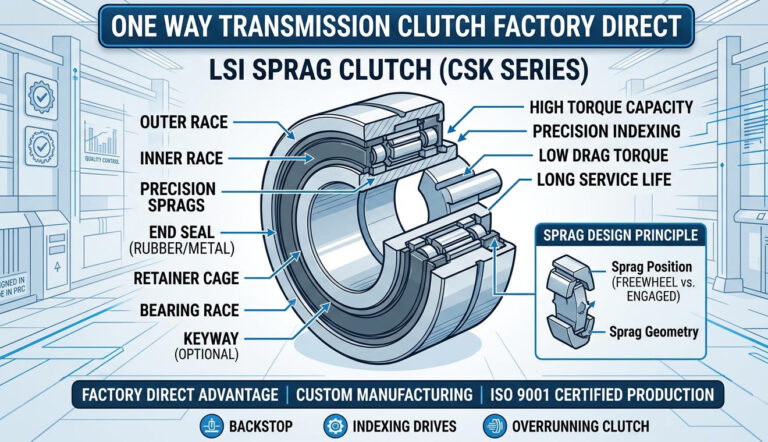

Custom One Way Cam Clutch OEM: Engineering Precision for Heavy Industrial Applications
For plant managers and operations directors, the failure of a single transmission component can halt an entire production line, leading to catastrophic downtime costs. Selecting a reliable custom one way cam clutch is not merely a procurement decision—it is a critical investment in operational continuity and safety. At LST Sprag, we specialize in high-performance freewheel technology designed to mitigate risks in heavy-duty conveyor systems, complex gearboxes, and high-speed indexing machinery.
This guide provides a deep technical dive into the engineering principles of cam sprag technology, selection criteria for OEM integration, and the quantitative metrics required to optimize your one way clutch for transmission systems.
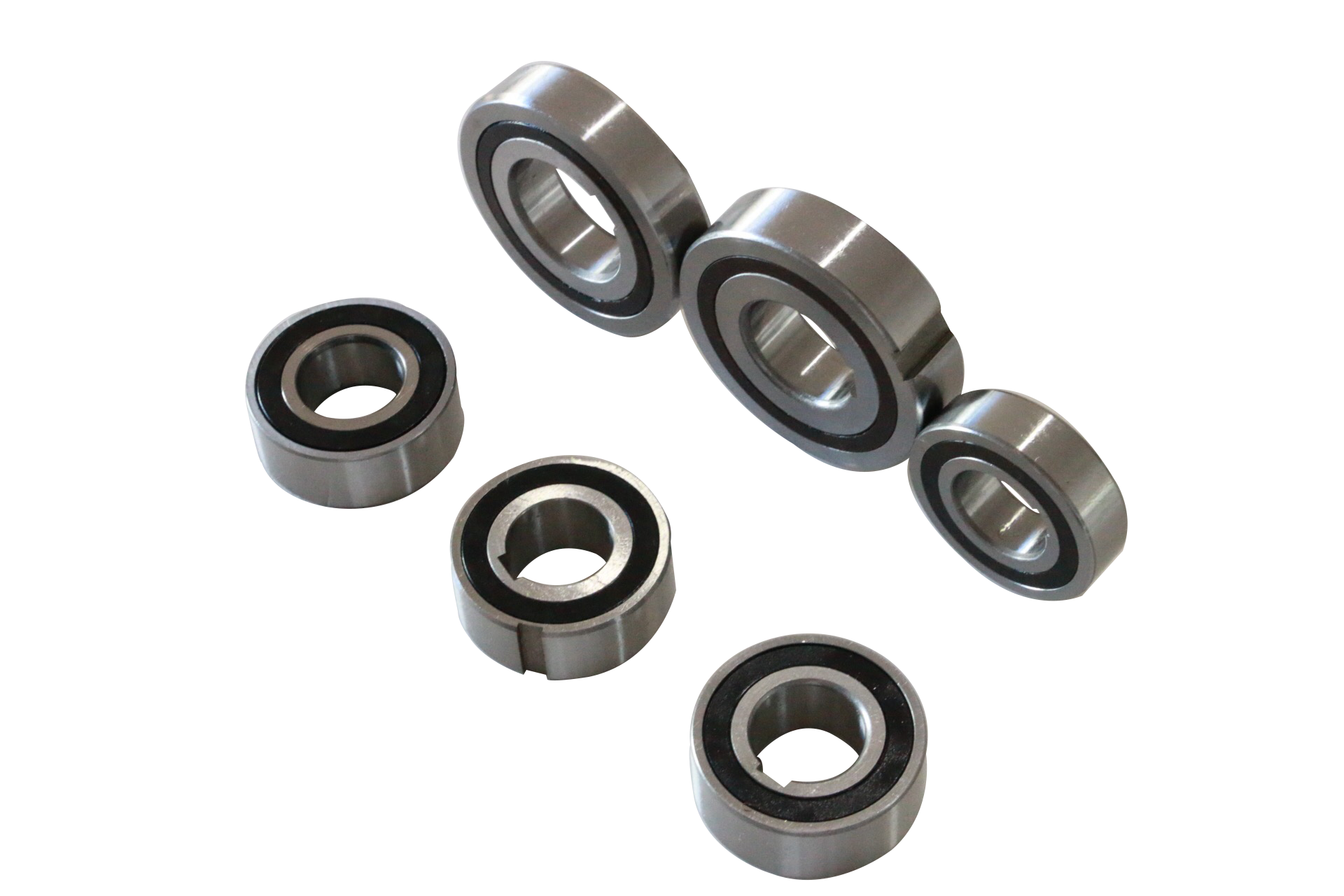
Understanding Cam Sprag Technology
A cam clutch, or sprag freewheel, functions as a mechanical diode. It utilizes a series of cam-shaped sprags placed between inner and outer races. When the input shaft rotates in the driving direction, the sprags tilt and wedge themselves, locking the races together to transmit torque. When the rotation reverses or the output speed exceeds the input, the sprags disengage, allowing free overrunning.
Core Advantages of Cam-Type Clutches
- Instant Engagement: Unlike roller-ramp designs, cam-type sprags offer immediate response time due to the geometry of the sprag contact points.
- High Torque Density: The compact nature of sprag assemblies allows for significant torque transmission in a minimal footprint.
- Wear Compensation: Advanced sprag profiles are engineered to distribute load across multiple contact points, extending service life in demanding industrial environments.
Technical Specifications and Performance Metrics
When specifying a custom one way cam clutch OEM, engineers must evaluate the intersection of torque capacity, RPM limits, and environmental conditions. The following table highlights common performance benchmarks for industrial-grade cam clutches.
| Specification | Light-Duty Application | Heavy-Duty Industrial | High-Speed Indexing |
|---|---|---|---|
| Torque Capacity | 50 – 200 Nm | 500 – 5000+ Nm | 200 – 1000 Nm |
| Max Overrunning RPM | 3000 | 1000 | 5000 |
| Lubrication | Grease | Oil/Bath | Oil Mist/Pressure |
Selection Guidance for OEM Integration
Selecting the right clutch for an OEM application requires a rigorous calculation of operational loads. You must account for dynamic load factors, especially in applications where shock loading or high-frequency cycling occurs.
Mathematical Calculation for Clutch Sizing
To determine the required service factor, apply the formula:
Treq = Tnom × Kf
Where Tnom is the nominal operating torque and Kf is the service factor derived from your machine’s daily duty cycle (typically 1.5 to 2.5 for heavy industrial conveyors).
Material and Surface Treatment
Depending on the operating environment (e.g., washdown facilities, dusty mining sites, or temperature-controlled cleanrooms), the material composition is critical. We recommend hardened alloy steel for high-load cycles, paired with specialized seals (Viton or Nitrile) to prevent lubricant contamination.
Comparative Analysis: Cam Clutch vs. Alternative Mechanisms
Choosing the correct mechanism is vital for TCO (Total Cost of Ownership) reduction.
| Feature | Cam/Sprag Clutch | Roller Ramp Clutch | Ratchet Mechanism |
|---|---|---|---|
| Engagement Speed | Instantaneous | Moderate | Low (Limited by Teeth) |
| Load Distribution | Multiple Sprags | Point Contact | Single Tooth Contact |
| Maintenance | Low (Sealed) | Medium | High |
Compliance, Safety, and Quality Standards
LST Sprag adheres to strict international manufacturing protocols. Any custom freewheel mechanism provided for international export must meet the following frameworks:
- CE Compliance: Ensuring machinery directive alignment for European market entry.
- ISO 9001:2015: Our quality management systems ensure repeatable precision for every batch.
- ANSI/AGMA Standards: Adherence to gear and transmission component safety codes for structural integrity under peak load.
Total Cost of Ownership (TCO) and Procurement Strategy
Procuring a custom one way clutch involves more than just the unit price. When evaluating suppliers, consider:
- Capex vs. Opex: A slightly higher upfront cost for a superior seal design significantly reduces Opex by extending maintenance intervals.
- Replacement Frequency: Ensure your supplier provides a clear MTBF (Mean Time Between Failures) estimate for your specific usage profile.
- Supply Chain Agility: Look for manufacturers with local inventory or established logistics to avoid production-halting lead times.
Frequently Asked Questions (FAQ)
Q: What is the recommended maintenance interval for heavy-duty cam clutches?
Typically, clutches in standard duty should be inspected every 2,000 operational hours. For heavy-duty applications with high vibration, inspection should be aligned with your gearbox service schedule (every 500-1,000 hours).
Q: Can custom sprag clutches be used for bi-directional movement?
No. Sprag clutches are inherently one-directional. For applications requiring bi-directional locking, please consult our engineering team regarding integrated shaft-locking solutions.
Q: How do environmental temperatures affect clutch performance?
High ambient temperatures can decrease the viscosity of lubricants, potentially leading to drag or improper engagement. Always specify temperature ranges during the OEM design phase so we can select the appropriate lubricant and seal material (e.g., silicone or Viton).
Q: Does LST Sprag offer modular designs?
Yes. Our modular product portfolio allows for customizable outer race dimensions and mounting flanges to fit legacy equipment footprints without requiring complete transmission redesigns.
Conclusion
Investing in a high-quality custom one way cam clutch is a strategic move to optimize the longevity and efficiency of your heavy equipment. By focusing on material integrity, precise engineering, and rigorous testing, LST Sprag ensures that your operations remain uninterrupted. For detailed technical inquiries or custom design consultations, please visit our resources page to explore our complete capabilities.
Designed according to ASME mechanical engineering standards, our custom sprag and cam clutches ensure optimal load distribution under severe industrial operating conditions.