Industrial Conveyor Backstop Clutch Guide: Engineering Reliability and Anti-Reversal Safety
For operations managers in the mining, cement, and bulk material handling industries, an unplanned reversal event on an inclined conveyor is more than a mechanical failure—it is a catastrophic safety risk and a massive financial liability. A failing or underspecified backstop clutch can lead to catastrophic damage to the drive train, destruction of the conveyor belt, and severe injury to personnel. As an expert conveyor backstop clutch manufacturer, LST Sprag Clutch understands that the integrity of your incline systems relies entirely on the immediate, zero-slip engagement of your anti-reversal mechanism.
This guide provides the technical framework necessary to evaluate, select, and maintain industrial conveyor anti reversal clutches, ensuring your equipment meets rigorous safety standards and performance expectations.
Understanding the Mechanics: Why Backstop Clutches are Mission-Critical
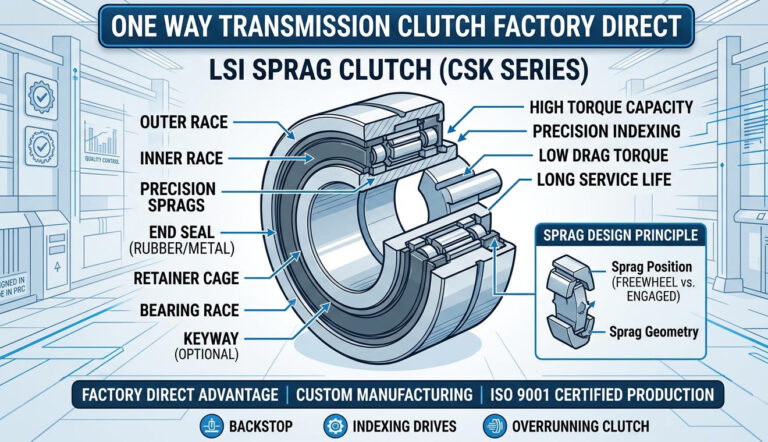
A backstop clutch is a high-precision, one-way mechanical freewheel component engineered to allow free forward rotation while providing instantaneous, rigid locking against reverse movement. In the context of heavy-duty material handling, these components serve as the final line of defense against the gravitational pull of loaded inclined conveyors or bucket elevators.
The Principle of Sprag Engagement
Unlike simple roller-ramp mechanisms, high-performance sprag-type clutches utilize a series of precision-engineered cams (sprags) positioned between an inner and outer race. When forward rotation occurs, the sprags tilt and allow the shaft to rotate freely with minimal drag. The moment reverse motion begins—even by a fraction of a degree—the sprags are forced into a locked position by the geometry of the races, effectively wedging the load in place.
Key Performance Metrics for Heavy-Duty Applications
- Locking Accuracy: The degree of angular backlash allowed before the clutch engages.
- Torque Resistance: The maximum allowable torque (measured in N·m or lb-ft) the clutch can withstand during a full load reversal.
- Thermal Management: Efficiency in dissipating heat generated during continuous high-speed forward rotation (overrunning).
Technical Comparison: Sprag vs. Roller-Ramp Clutches
Choosing the wrong technology can result in premature wear or, worse, failure to engage under load. The following table provides a breakdown of why sprag configurations are preferred for heavy-duty industrial applications.
| Feature | Sprag Type (LST Standard) | Roller-Ramp Type |
|---|---|---|
| Load Distribution | High (multiple sprag contact points) | Lower (concentrated point contact) |
| Backlash | Near Zero | Moderate |
| Life Expectancy | High | Low to Moderate |
| Engagement Speed | Instantaneous | Slower (Requires ramp engagement) |
Selection Criteria: Matching Hardware to Operational Demand
Procurement specialists must account for more than just physical shaft size. When evaluating a belt conveyor backstop assembly, engineers should calculate the required torque based on the maximum incline angle and the maximum load capacity of the conveyor belt.
Calculating Required Torque (T)
The torque capacity is determined by the formula: T = (W × L × sin(θ) × R) / η
- W: Total weight of the material and belt (N)
- L: Length of the incline
- θ: Angle of inclination
- R: Radius of the drive pulley
- η: Efficiency factor of the gearbox
Compliance and Global Safety Standards
As a global conveyor backstop manufacturer, LST Sprag Clutch designs components that adhere to international benchmarks. Compliance is not optional; it is the baseline for insurance and operational safety certifications.
- ISO Compliance: All design and manufacturing processes align with ISO 9001 standards to ensure material consistency and dimensional accuracy.
- Safety Standards: Our products are designed to support compliance with OSHA (Occupational Safety and Health Administration) regulations regarding machine guarding and fail-safe operation.
- CE Certification: Ensuring all exported units meet the health, safety, and environmental protection standards for the European Economic Area.
Total Cost of Ownership (TCO): Capex vs. Opex
Investment in a premium bucket elevator backstop clutch should be viewed through the lens of TCO. A lower initial purchase price often masks significant operational risks:
- Capex: The initial unit cost, installation labor, and initial configuration testing.
- Opex: The cost of downtime, manual lubrication schedules, and premature bearing replacement.
Buying Checklist for Procurement:
- Confirm the peak torque requirements under a fully loaded stall condition.
- Verify the shaft tolerance and keyway dimensions against ISO standards.
- Request the specific lubrication maintenance cycle (e.g., grease vs. oil bath requirements).
- Confirm the availability of maintenance manuals and local technical support.
FAQs: Addressing Common Operational Concerns
How often should I inspect my conveyor backstop clutch?
For heavy-duty applications in mining or cement, we recommend a visual inspection every 500 operating hours. Check for signs of lubricant leakage, which may indicate a failing seal, and ensure there is no audible metal-on-metal noise during startup.
Can your clutches be used for both low and high-speed applications?
Yes, LST Sprag Clutches are engineered for high-speed overrunning performance. However, application-specific heat dissipation requirements must be reviewed if the clutch operates continuously at speeds exceeding 70% of its rated capacity.
What is the lead time for custom shaft configurations?
As a factory-direct manufacturer, we specialize in custom modular manufacturing. Standard units are typically ready for shipping within 1-2 weeks, while specialized OEM configurations are managed via a dedicated project timeline to ensure quality compliance.
For inquiries regarding your specific conveyor overrunning clutch requirements, contact our technical engineering team today to ensure your systems remain secure, compliant, and efficient.