The Ultimate Engineering Guide to One-Way Sprocket Clutches: OEM Design, Selection, Specifications & TCO Analysis
1. Executive Summary & Company Profile: Precision Engineering by Auto Sprag Clutch Factory
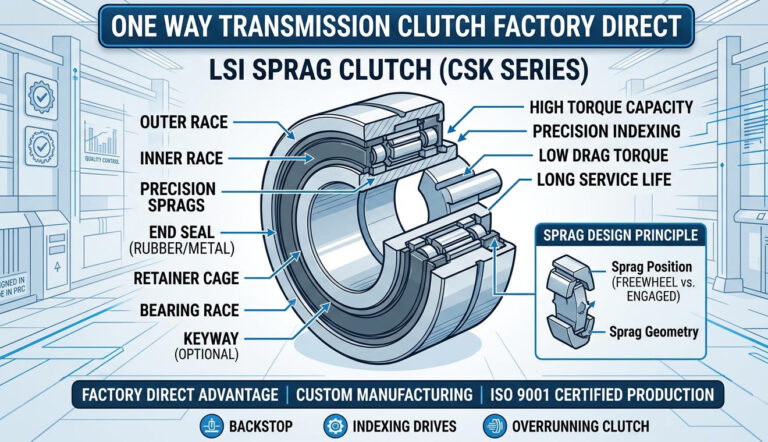
In modern industrial motion control, reversing loads and unwanted back-rotation represent primary causes of catastrophic mechanical failure, motor burnouts, and costly assembly line downtime. The One-Way Sprocket Clutch—often referred to as a sprocket freewheel assembly or overrunning sprocket clutch—serves as a vital mechanical safety interface. It seamlessly integrates a precision-machined chain sprocket with an internal freewheel mechanism (utilizing sprag or roller ramp technology), allowing power transmission in one rotational direction while freewheel-disengaging in the opposite direction.
At Auto Sprag Clutch Factory, we specialize in the custom engineering, precision heat treatment, and volume OEM manufacturing of heavy-duty power transmission components. Operating advanced CNC grinding technology and automated inspection lines, our factory delivers direct-interchange and custom-designed one-way clutches engineered for extreme industrial environments.
Our complete product lineup includes:
- One-Way Clutches: High-precision indexing, overrunning, and backstopping units for industrial automation.
- Sprag Clutches: Wedge-cam friction mechanisms engineered for instant engagement and zero backlash.
- Backstop Clutches: Heavy-duty safety reversal protection systems tailored for incline belt conveyors and bucket elevators.
This comprehensive technical manual provides mechanical engineers, plant operators, and procurement specialists with an in-depth understanding of one-way sprocket clutches—covering kinematics, material metallurgy, dimensional standards, maintenance guidelines, troubleshooting, and total cost of ownership (TCO) optimization.

2. Mechanical Principles & Kinematics of One-Way Sprocket Clutches
2.1 Fundamental Working Principle
A one-way sprocket clutch operates on the principle of directional friction wedge-locking. Unlike standard roller chains that transfer torque bi-directionally, a sprocket freewheel contains an inner race, an outer race (integrated directly into or bolted to the sprocket hub), and intermediate locking elements (hardened sprags or spring-loaded cylindrical rollers).
- Driving / Engagement Mode: When the input shaft or sprocket rotates in the driving direction, the internal locking elements immediately wedge between the inner and outer races. Friction transforms rotational torque into rigid mechanical engagement, driving the driven equipment.
- Freewheeling / Overrunning Mode: When the output speed exceeds the input speed or when shaft rotation reverses, the locking elements slip over the race surfaces smoothly against precision springs, allowing the sprocket to freewheel with minimal drag torque.
Operational State Breakdown:
- Driving Mode: Input Torque activates internal Wedge Action, causing the Outer Race / Sprocket and Inner Shaft to achieve Solid Torque Transfer without slip.
- Freewheeling Mode: Speed Differential activates Sprag Lift/Slip against internal springs, achieving Instant Zero Backlash Disengagement and drag-free overrun.
2.2 Mechanical Kinematic Calculations
When evaluating a sprocket freewheel for custom machinery, engineers must calculate the dynamic torque, overrunning friction losses, and service life expectations under high-cycle dynamic conditions.
The nominal transmitted torque is calculated using the standard power transmission equation: T_nom = (9550 * P / n) * Ks
Where:
- P = Transmitted power in kilowatts (kW)
- n = Shaft speed in revolutions per minute (RPM)
- Ks = Application service factor (typically 1.5 to 3.0 based on shock load severity according to AGMA Power Transmission Guidelines)
To prevent premature fatigue pitting on the contact surfaces, the contact stress generated between the locking geometry and the raceway must remain strictly below allowable fatigue limits, taking into account normal wedge forces, race curvature radii, material elasticity, and effective contact width.
3. Detailed Dimensions & Technical Specifications Comparison
Selecting the correct one-way sprocket clutch requires matching chain pitch, tooth count, bore diameter, keyway dimensions, and torque threshold. The following table outlines standard industrial dimensions for heavy-duty sprocket clutches manufactured at our facility:
- Model Series: LST-SP40-12 | Chain Pitch: ANSI 40 (1/2 in) | Tooth Count: 12-18 | Max Bore Range: 12-25 mm | Nominal Torque: 180 Nm | Max Overrunning Speed: 2,200 RPM | Weight: 1.4 kg
- Model Series: LST-SP50-15 | Chain Pitch: ANSI 50 (5/8 in) | Tooth Count: 15-24 | Max Bore Range: 15-35 mm | Nominal Torque: 450 Nm | Max Overrunning Speed: 1,800 RPM | Weight: 2.8 kg
- Model Series: LST-SP60-18 | Chain Pitch: ANSI 60 (3/4 in) | Tooth Count: 18-30 | Max Bore Range: 20-45 mm | Nominal Torque: 920 Nm | Max Overrunning Speed: 1,500 RPM | Weight: 5.2 kg
- Model Series: LST-SP80-20 | Chain Pitch: ANSI 80 (1 in) | Tooth Count: 20-32 | Max Bore Range: 30-65 mm | Nominal Torque: 2,400 Nm | Max Overrunning Speed: 1,200 RPM | Weight: 11.5 kg
- Model Series: LST-SP100-24 | Chain Pitch: ANSI 100 (1-1/4 in) | Tooth Count: 24-40 | Max Bore Range: 45-90 mm | Nominal Torque: 6,500 Nm | Max Overrunning Speed: 900 RPM | Weight: 24.0 kg
- Model Series: LST-SP120-Custom | Chain Pitch: ANSI 120+ / ISO 24B | Tooth Count: Custom | Max Bore Range: 60-130 mm | Nominal Torque: 15,000+ Nm | Max Overrunning Speed: 600 RPM | Weight: Custom
Keyway & Shaft Fit Specifications
- Bore Tolerances: Machined to ISO H7 or H6 limits. Shaft journals should be precision-ground to ISO g6 or h6 according to ISO Quality Management Standards.
- Keyways: Manufactured in full compliance with DIN 6885/1 or ANSI B17.1 standard dimensions.
- Sprocket Tooth Profile: Hardened sprocket teeth precision-hobbed to DIN 8187 / ANSI B29.1 standards to minimize chain engagement wear.
4. Metallurgy, Material Engineering & Manufacturing Processes
The longevity of a one-way sprocket clutch under combined dynamic chain loads and rapid engagement cycles depends directly on material selection and heat treatment precision.
Manufacturing Process Flow:
- Raw Material Selection: High-grade SAE 8620H, GCr15 bearing steel, or 1045 medium carbon steel.
- Precision CNC Machining: Sprocket tooth hobbing and race precision turning.
- Controlled Atmosphere Heat Treatment: Carburizing case depth of 1.2 mm to 1.8 mm, achieving 60-64 HRC surface hardness.
- CNC Race Grinding: Sub-micron profile grinding with surface roughness Ra under 0.2 micrometers.
- Quality Verification: Automated CMM dimensional audit and 100% torque stall testing.
Material Selection Breakdown
- Inner & Outer Races: Premium SAE 8620H or 20CrNiMo carburizing alloy steel. Case-hardened to 60-64 HRC with an effective carburized depth of 1.2 mm to 1.8 mm to prevent surface spalling under peak shock loads.
- Sprags & Locking Rollers: High-carbon chromium bearing steel (AISI 52100 / GCr15), vacuum-degassed and hardened to 62-66 HRC for ultra-low wear rates during freewheeling.
- Sprocket Tooth Ring: Medium carbon steel (AISI 1045 / 42CrMo4), induction hardened along tooth flanks to 50-55 HRC to endure continuous roller chain friction without chain pitch elongation.
- Retention Springs: High-tensile stainless steel (SUS304 / 17-7PH) ensuring uniform, instantaneous wedge engagement across temperatures from -40 degrees C to +120 degrees C.
5. Industrial Applications & Case Studies
One-way sprocket clutches provide indispensable driving and disengagement functions across diverse automated industries:
5.1 Dual Drive & Auxiliary Drive Conveyors
In heavy material handling plants, main electric motors are paired with low-speed auxiliary drives for positioning, inspection, or maintenance. A one-way sprocket clutch mounted on the auxiliary drive shaft allows the auxiliary motor to drive the system at low RPM. Once the primary motor fires up, the sprocket clutch automatically overruns, completely isolating the auxiliary drive without mechanical gear shifting.
5.2 Packaging & Indexing Machinery
High-speed packaging, printing, and labeling lines require precise intermittent rotational indexing. A reciprocating crank or pneumatic cylinder drives the outer sprocket; the internal clutch converts linear push-pull actions into smooth forward shaft indexing while slipping back on the return stroke.
5.3 Agricultural Equipment & Harvesters
On combine harvesters and balers, rotating cutter heads generate massive rotational inertia. When the tractor PTO disengages, the heavy cutter can back-drive and shear the main transmission gears. A heavy-duty sprocket clutch permits the cutter assembly to coast freely down to a safe stop.
6. Installation, Maintenance & Lubrication Guidelines
6.1 Step-by-Step Installation Protocol
- Shaft Inspection: Inspect the mating shaft for burs, keyway distortion, or runout. Ensure shaft runout is under 0.02 mm.
- Alignment: Align the drive sprocket and driven sprocket with a laser alignment tool to prevent axial misalignment and uneven internal sprag loading.
- Mounting: Press-fit the clutch onto the shaft using an arbor press or threaded shaft puller. Never strike the inner race or sprocket hub with a hammer.
- Keyway Seating: Ensure the drive key fits snug laterally without vertical binding.
6.2 Lubrication Requirements
Proper lubrication reduces friction during the overrunning cycle while enabling clean friction locking during drive engagement.
- Grease Lubrication: Recommended for low-to-medium speed operations under 1,200 RPM. Use high-grade lithium-complex grease without extreme pressure (EP) additives containing molybdenum disulfide or graphite, as solid slip additives prevent sprags from locking securely.
- Oil Bath / Circulation: For high-speed applications exceeding 1,200 RPM, use non-EP synthetic gear oils or automatic transmission fluid (ATF) matching ISO VG 32 to VG 68 viscosity standards.
7. Total Cost of Ownership (TCO) & ROI Analysis
When procuring industrial power transmission components, initial unit purchase price accounts for less than 15% of the total life-cycle expense. Unscheduled plant downtime caused by premature clutch failure can exceed tens of thousands of dollars per hour.
Total Cost Breakdown:
- Initial Purchase Price: 15%
- Energy & Friction Drag: 10%
- Routine Maintenance & Lubrication: 15%
- Unscheduled Downtime & Machine Damage (due to low-quality units): 60%
By specifying precision-engineered units from Auto Sprag Clutch Factory, industrial operations achieve:
- Up to 300% Extended Service Life: Precision CNC race grinding eliminates localized stress peaks.
- 99.9% Operational Uptime: Automated 100% torque stall testing ensures zero unexpected slippage.
- Direct Cost Savings: Factory-direct OEM sourcing eliminates intermediary distributor markups, cutting procurement costs by 25% to 40%.
8. Frequently Asked Questions (FAQ)
Q1: Can a one-way sprocket clutch be used as a primary safety backstop on inclined conveyors?
A: While a sprocket clutch can provide backstopping capabilities on light-to-medium conveyors, severe incline applications with heavy bulk materials should utilize dedicated high-torque Backstop Clutches featuring heavy-duty torque arms directly mounted to reducer shafts.
Q2: What happens if EP (Extreme Pressure) grease containing Moly is used?
A: EP additives create a permanent low-friction microscopic barrier on internal metal races. This causes sprags or rollers to slip rather than wedge during driving mode, leading to complete engagement failure.
Q3: How do I determine whether I need a Sprag design or Roller Ramp design?
A: Sprag designs offer higher torque density within a compact radial space and zero engagement backlash. Roller ramp designs excel in harsh environments with heavy shock loads or where oil viscosity fluctuates widely. Consult our engineering team at Auto Sprag Clutch Factory for custom selection assistance.